
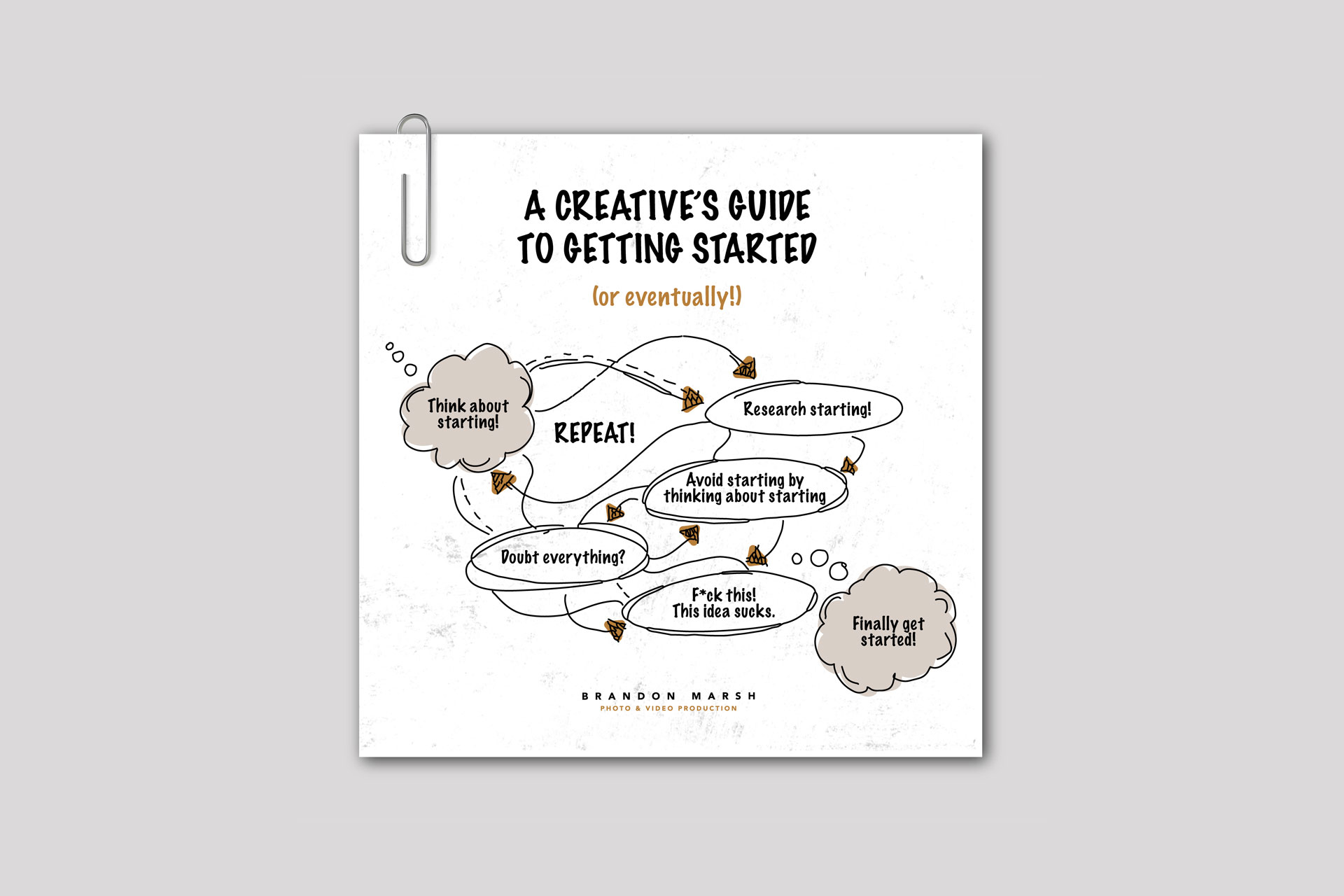
Why getting started rarely feels simple for creatives
As someone who has always explored some form of creative practice, loves to research, and experiment with new ways of applying ideas, there’s a subject that rarely gets talked about.
The process of getting started.
It’s the beginning of a new year, and I’m finding a lot of friction in getting back into a routine. Everything feels heavier than it should. I know there’s a process to every process, but defeat often sets in long before I even get started.
After decades of research into my own creative patterns, I’ve realized I often move through very specific stages before anything actually begins. So rather than letting that feeling of defeat overtake me, I decided to study these stages further.
Scientifically, of course.
For me, the vicious cycle usually looks something like this:
- Think about starting
- Research starting
- Avoid starting by thinking about starting
- Doubt everything
- The idea sucks
Repeat steps 1–5… or finally get started
To paint a clearer picture, let’s dive into these stages in more detail.
Step 1: Think About Starting
This is the moment of confrontation, right after an idea is born. In this case, writing this article.
Maybe I’m already sitting at my desk. Maybe the thought arrives while I’m doing laundry or standing in the shower. Either way, the big bang has happened, and I’m suddenly filled with inspiration to get started.
It’s kind of like that moment in a Sunday morning cartoon when a light bulb appears over the character’s head. There’s a spark. Nothing more. Action to come later
Step 2: Research Starting
Every idea needs time to bloom, right?
This is where I start researching endlessly. Reading. Watching. Bookmarking. Filing things into folders I will never look at again. Falling down rabbit holes that feel adjacent enough to justify themselves.
Somehow, even with all this newfound wealth of knowledge, I’m now further away from understanding my original idea.
But guess what. I now know how to cook lasagna in a dishwasher.
Step 3: Avoid Starting by Thinking About Starting
This is the peak procrastination period.
I clean my workspace. Then organize my equipment for the second time this week. Visit Ash in her office. Make food. Go for a walk. Play with my dogs. Go for a bike ride. Play with the dogs again.
All of this feels productive in some way. But I’m still far from actually moving forward.
Eventually, I may choose a moment to sit down. Or I may not. Either way, I’m very busy preparing to begin.
Step 4: Self-Doubt
This is the moment focus finally shows up and immediately starts asking questions that don’t need to be answered yet.
I begin reviewing everything. Notes. Half-formed thoughts written during previous stages of avoidance. I start noticing holes in the idea. The act of problem-solving reveals even more problems.
Does this make sense?
Will anyone even care?
What’s the purpose?
What’s my purpose?
Well, that escalated quickly…
Why should I even try when the world is buried in snow, World War III feels imminent, AI is taking over, everyone has an OnlyFans, and everything feels deeply fucked?
– Brandon Marsh
Step 5: The Idea Sucks
Fuck it. The idea sucks. Back to the drawing board.
This was a complete waste of time. My funds are running low. I need to market. I need to put something out. I’m going to be forgotten, and all I’ve really learned is how to make lasagna in a dishwasher.
Why should I even try when the world is buried in snow, World War III feels imminent, AI is taking over, everyone has an OnlyFans, and everything feels deeply fucked?
Breathe in.
Breathe out.
Woosah.
We either repeat steps one through five, or we let go, trust the process, and move forward.
Eventually, you either start, or you become very educated about not starting.
There are days when nothing seems to come together. Getting started feels impossible. But even thinking about starting is a form of movement. Sometimes it’s the only movement available. I often forget this.
And maybe that’s the part we overlook.
Letting the Process Be the Proces

For as long as it can take to finally begin, I’ve stopped dismissing the value of this phase and started recognizing it as part of the process itself. Because for me, it’s led to something quieter and more important.
A deeper understanding of myself.
My values.
My patterns.
My identity.
For any self-branded business owner, the line between who we are and what our business is can get dangerously thin. Over time, the work we do on ourselves begins to carry the same weight as the work we do on the business.
Still, feeling stuck isn’t always an identity issue. Sometimes it has nothing to do with the idea at all. Sometimes it’s the result of trying to force clarity before alignment has caught up.
And maybe that’s the real tension.
This phase is where some people feel tortured by their craft. Others find inspiration by loosening their grip. By letting the idea exist without demanding immediate performance. By allowing uncertainty to be part of the work, not a sign of failure.
When I first started this journey, being paid to be creative just sort of happened. I didn’t overthink it. Now, I can’t stop thinking about what I’m building, why I’m building it, and what I’m leaving behind.
Not because anyone is paying attention, but because I am.
Through this process, I’m learning to accept that showing up is still something. Whether I allowed curiosity to exist without guilt. Whether I trusted that movement doesn’t always look like momentum. Or whether I managed to stray outside the confines of my box.
Over the decades, I’ve learned that getting started doesn’t mean producing something right away.
Sometimes it just means staying in the room long enough for the idea to realize it’s safe to exist…
If you’re a creative who feels stuck in the cycle of thinking, researching, and avoiding, this guide is a reminder that getting started rarely looks clean.
Many creatives I speak with work across photography, design, writing, filmmaking, and other creative practices. They are not lacking ideas or motivation. More often, they are caught between knowing they should start and feeling ready to do so.
If that sounds familiar, you are not alone. And if you are a creative looking for clarity, perspective, or simply a place to talk things through, you are always welcome to reach out and start a conversation.
– Brandon

Leave a Reply


For Architects, Interior Designers, & Custom Homebuilders
Pre-Shoot Checklist
Real experiences create something staged content cannot. When people interact naturally with a space, product, or service, the result is imagery that feels lived in, relatable, and far more meaningful to your audience.
Real Experiences

Why Real Experiences Create Better Lifestyle Content for Brands
Still images document a project, but video brings it to life. By adding motion, pacing, and perspective, you can communicate the experience of a space in a way that feels more immersive and engaging.
adding video

Why Every Interior & Architectural Shoot Should Include Video
Creating content without a plan often leads to scattered results. This blueprint focuses on building a structured approach that helps you create with intention, stay consistent, and develop a library of visuals that supports your work over time.
Planning Content

The Content Creation Blueprint
Cost-sharing is a simple way to get more out of your investment in photography and video. By collaborating with other contributors on a project, you can reduce costs, streamline the process, and create a cohesive set of visuals that benefits everyone involved.
COST-sharing

Cost Sharing: A Guide for Architects, Interior Designers & Home Builders

Getting started is rarely the problem. It is the waiting, overthinking, and searching for the right moment that holds most people back. This piece looks at why progress often begins long before we feel ready, and what it actually takes to move forward.
Creative Perspective
Be the first to comment